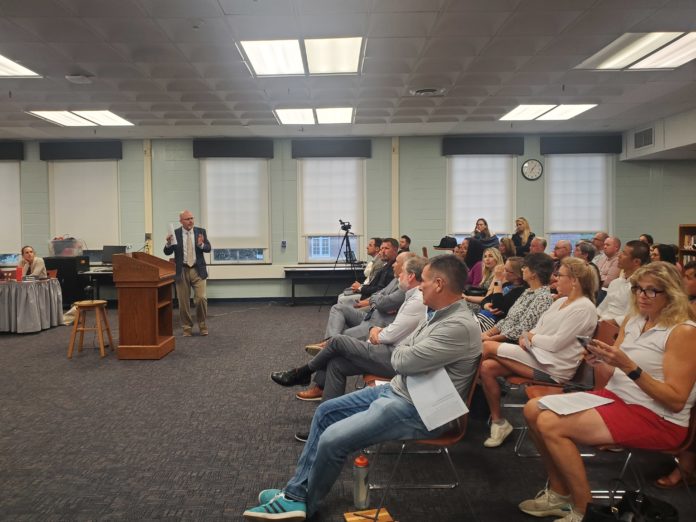

On Thursday, the Haddonfield Board of Education voted unanimously to approve the tentative budget for the 2026-2027 fiscal year proposed by schools superintendent Charles Klaus and Business Administrator Michael Catalano, sending it to the Camden County executive superintendent for approval ahead of final adoption by the board in May. The $51.7 million operating budget is a $3 million increase from the current fiscal year, paid for by a 5.95% increase in the school property tax levy. Thanks to an increase in property valuations over the past year, the effective tax increase will be 4.99%; for the average home in Haddonfield, that works out to $467 more annually.
While taxes are increasing, however, programs and staffing would be reduced under the budget. Cooking classes at Haddonfield Memorial High School will be eliminated for next year with the retirement of Arleen Iavicoli, known to students as Mrs. I, in June. Five teachers’ aides, a part-time district office staff member, and a math or science teacher at the middle or high school will be laid off. Extracurricular stipends and sports competition schedules will be reduced. And multiple initiatives, including cybersecurity upgrades and additional teachers for full-day kindergarten beginning in 2028, will be deferred to future years.
The primary cause of the district’s budgetary woes is increased healthcare costs, which grew by $1.5 million or 18%, according to Mr. Klaus at the March 17 board meeting. “If they went up 10%, we’d be looking at a very different budget right now,” he said then. Anticipating difficult choices, district leaders began the process of public consultations and searching for savings earlier than usual. Meetings with school PTA groups began in January, and the board first discussed priorities and heard proposals for tax changes and spending cuts from Mr. Klaus and Mr. Catalano in February.
Since then, district administrators have been searching for cost savings or additional revenue sources that could offset tax increases and cuts to staff or essential programs. A tiered activity fee system was developed, a redundant website was eliminated, and planned classroom furniture replacements were canceled. Good news also came on March 12 when state aid amounts for next fiscal year were released, with Haddonfield receiving $49,000 more when administrators had been planning for a significant cut.
In just the past week, Mr. Klaus said on Thursday, two teacher positions that would have been cut were added back to the budget due to projected revenue increases from raising facility use fees. The district’s five principals met and spent hours tinkering with schedules to share staff between schools and avoid spending $41,000 on a new part-time position. And the principals, assistant principals, supervisors, and directors who make up the Haddonfield Administrators and Supervisors Association chose to give up some contractually-mandated benefits and perks, Mr. Klaus reported. Still, these developments were not enough to close the gap without staff cuts.
Some Haddonfield residents have said online in recent weeks that the district should focus on cutting administrative salaries and other expenses. Mr. Klaus has emphasized the district’s “leanness” at previous board meetings, and on Thursday, Mr. Catalano presented data showing that Haddonfield had the third-lowest administrator-to-student ratio when compared to 17 surrounding school districts, and the lowest in District Factor Group J, which is made up of towns with similar socioeconomic statistics.
Before the vote to approve the budget, board members praised what they described as an open process. “I think there are some advantages to moving up the timeline and being as proactive as possible,” said member Stephanie Benecchi, while also acknowledging the workload for the board and administrators. Member Matt Ritter commended principals for their last-minute collaboration to find additional cost savings, saying that it “made a huge difference.” But the board has also expressed its dissatisfaction with the external factors, from unfunded mandates to state aid formulas, that it says tie local leaders’ hands. “We have to statutorily fill requirements and keep them within a cost” that the district has no control over, said Board President Jaime Grookett. “It’s a frustrating exercise.”
And while Haddonfield’s current position may be better than surrounding towns (according to The Retrospect, Collingswood is planning to close an elementary school and Audubon is proposing a tax hike of almost 10% in response to state aid cuts and healthcare increases), district leaders are gloomy about the future without major structural changes to school funding in New Jersey. Mr. Klaus called the nominal 2% cap on tax increases a “fallacy” at the March 17 board meeting, saying that “our health insurance is rising out of control, everything is going up, and 2% is an antiquated number.” He told the board that “we’re going to be having the same conversation next year,” and that the “bailouts” enjoyed this year may not be available.